
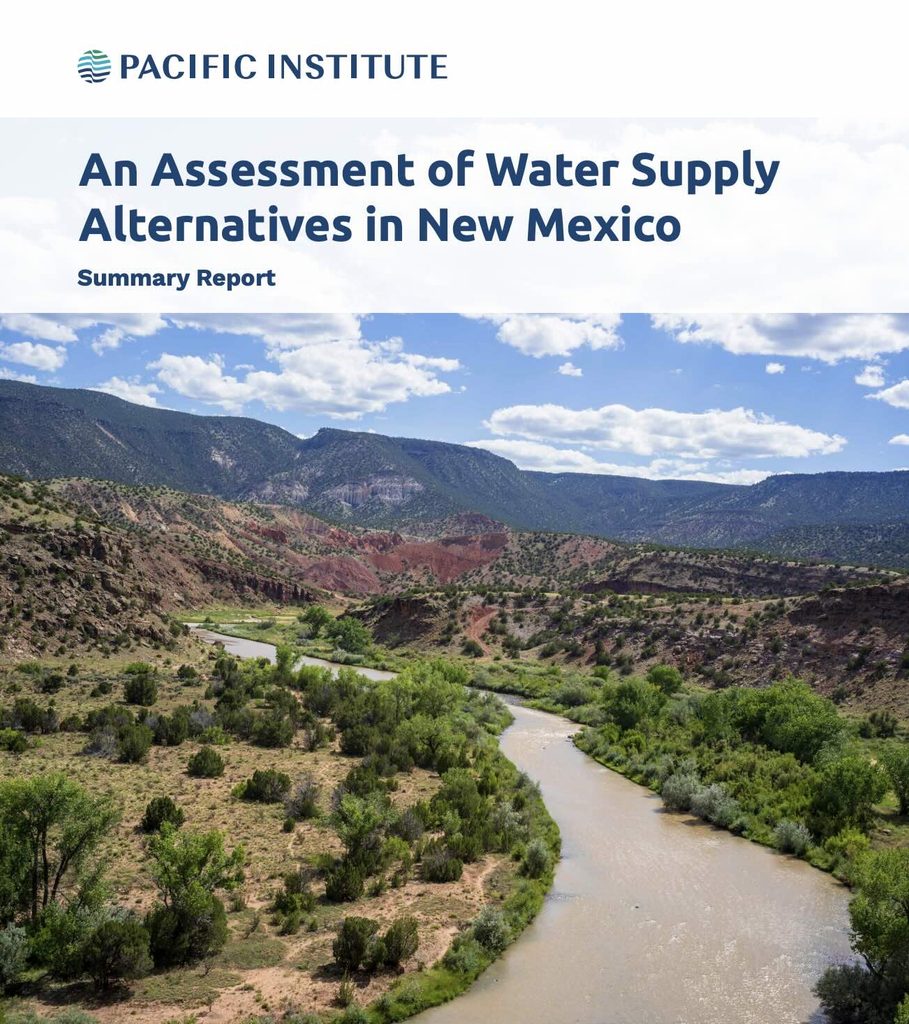
Santa Fe, NM — As New Mexico plans for a future in which water availability could decline by roughly 25% over the next 50 years, a new Pacific Institute report provides a comparative analysis of six water supply alternatives to inform future water planning and investment decisions.
The report, “An Assessment of Water Supply Alternatives in New Mexico,” examines the technical potential and costs of six major water supply alternatives. It comes as New Mexico faces significant challenges from drought and aridification, aging infrastructure, and increasingly extreme precipitation, which strain the state’s already overallocated rivers and aquifers. The report assesses water supply alternatives to inform time-sensitive strategic investment decisions to meet the long-term water needs of New Mexico farmers, cities and towns, industry, and the environment.
“The Thornburg Foundation recognizes the critical need to support evidence-based information to guide water policy decisions as the state tackles the growing imbalance between water supply and demand,” said Allan Oliver, President of the Thornburg Foundation. “The Pacific Institute’s report provides a deeper understanding of both the benefits and challenges associated with alternative water sources.”
The assessment evaluates agricultural conservation, municipal and industrial conservation, municipal and industrial wastewater reuse, urban stormwater capture, produced water recycling and reuse, and brackish groundwater desalination.
The assessment found that agricultural and municipal conservation offer some of the largest and often most cost-effective opportunities to extend existing water supplies. Agricultural conservation strategies could reduce water withdrawals by more than 600,000 acre-feet annually, a volume roughly equivalent to nearly twice the full storage capacity of Caballo Reservoir. Municipal and industrial conservation could reduce water use by 164,000 to 196,000 acre-feet annually, approximately equal to the full storage capacity of El Vado Reservoir.
“Just as New Mexico doesn’t face a single water challenge, there is no single solution,” said Michael Cohen, Senior Fellow at the Pacific Institute and an author of the report. “The findings point to significant opportunities to build on New Mexico’s progress in conservation while carefully evaluating which additional strategies make sense for individual communities and basins.”
Rather than promoting a single solution, the report provides a framework for comparing the potential, costs, and practical considerations associated with six water supply alternatives. Its findings can help identify and prioritize near-term investments while highlighting areas where additional investigation is needed to support informed decision-making.
###
Media Contact:
Russell Hawkins
Thornburg Foundation
[email protected]
864.431.1341
Founded in 1999, Thornburg Foundation is a family foundation based in Santa Fe that seeks to advance systems change that serves the public good. The Foundation uses an evidence-based strategic approach to make grants to nonprofits focused on K-12 Education, Water, Land, and Housing. For more information on Thornburg Foundation’s policy funding, visit thornburgfoundation.org.
Founded in 1987, the Pacific Institute is a global water think tank that combines evidence-based thought leadership with active outreach to influence local, national, and international efforts in developing sustainable water policies. From working with Fortune 500 companies to frontline communities, our mission is to create and advance solutions to the world’s most pressing water challenges. Since 2009, the Pacific Institute has also acted as co-secretariat for the CEO Water Mandate, a global commitment platform that mobilizes a critical mass of business leaders to address global water challenges through corporate water stewardship. For more information, visit pacinst.org.