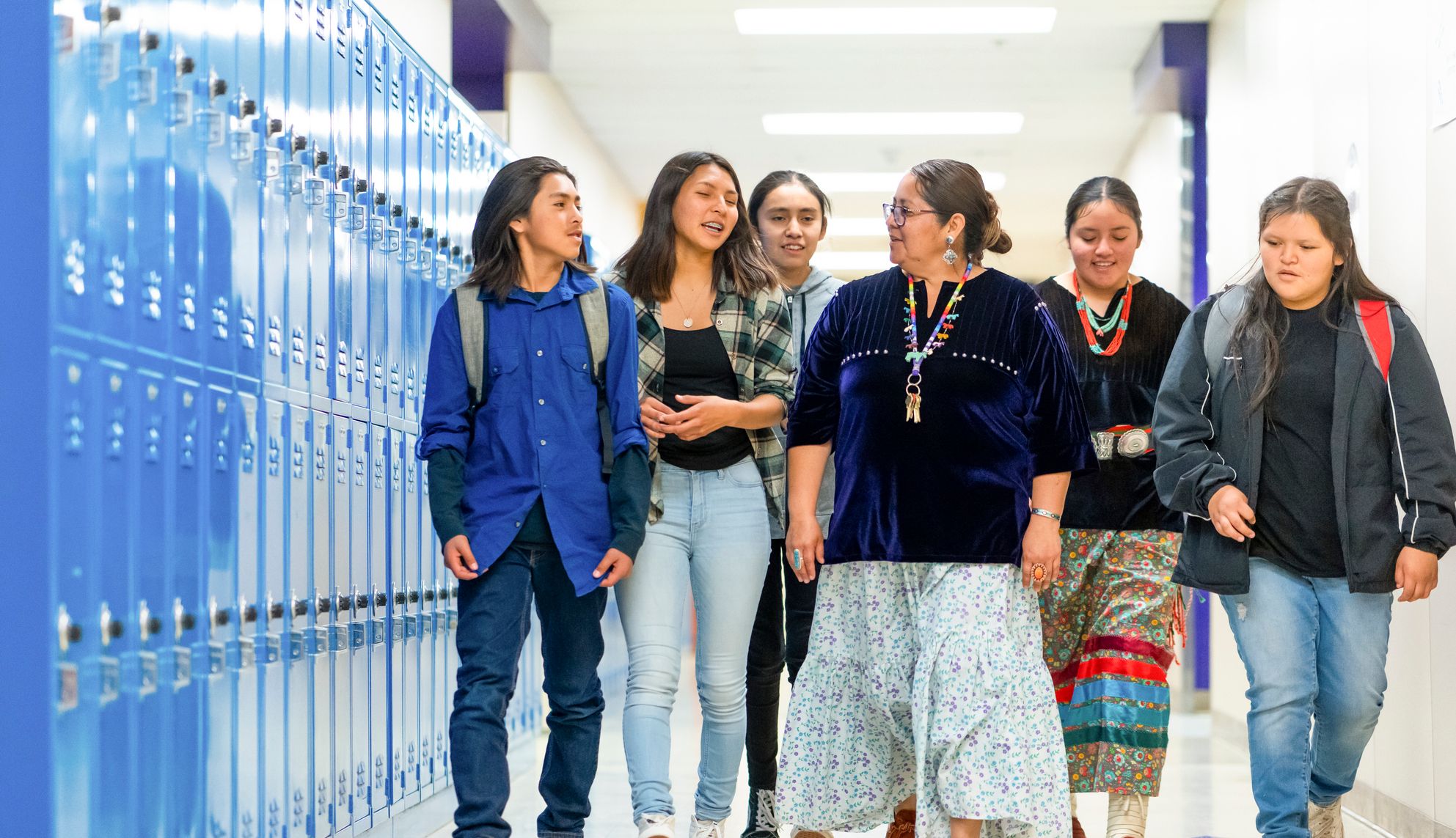
A world-class education for every New Mexico student.
Our K-12 Education Initiative invests in the educators and experiences that build a school system on par with the world’s best.
The Thornburg Foundation envisions a world-class education for all New Mexico students. To achieve this, the Foundation's K-12 Education strategy focuses on recruiting, training and retaining exceptional educators and providing students with relevant, meaningful and valuable educational experiences — building a system on par with those in Finland, Singapore, Japan and other top-performing countries.
Get K-12 Education updates
Grant announcements and news from this initiative.

Investment that's paying off, one classroom at a time.
Too few students are thriving in a system that undervalues its teachers.
Academic performance and engagement
Statewide, only one in four New Mexico students is proficient in math, and more than half struggle to meet grade-level reading benchmarks. Declining enrollment, rising disengagement and chronic absenteeism signal the need for system-wide change.
An undervalued teaching profession
The career of teaching is not consistently well-respected or attractive. In the world's strongest education systems, teaching is among the highest-compensated and most-respected careers. New Mexico must make the levers within its control — recruitment, preparation and retention — work together to elevate the profession.
A lack of relevance and rigor
Students do not always find meaning, value and relevance in their education. To reverse the decline in education's perceived value, New Mexico must increase its relevance and rigor in the modern economy.

Two connected strategies.
Lasting educational improvement comes from sustained, coordinated investment in educators and students — not from cycling through one reform after another.
Educator Ecosystem
A thriving educator ecosystem focuses on the recruitment, preparation and retention levers that make teaching a well-respected career — competitive salaries, high-quality preparation through residencies and well-supported teachers with professional autonomy and opportunities for team leadership.
- Increasing compensation and expectations for effective educators — In leading education systems worldwide, teaching is a respected, well-compensated career that attracts top talent. We partner with organizations exploring how competitive salaries, coupled with high expectations, can elevate the profession in New Mexico and strengthen its educator pipeline.
- Guiding teacher residency and leadership training program implementation — Teachers who complete clinical preparation with strong mentorship and induction are better prepared, stay in the classroom longer and contribute to stronger academic gains. We continue to support teacher and school leader residencies with the goal of universal residencies for all incoming teachers.
- Promoting team teaching and innovative staffing — The top reason educators leave the profession is dissatisfaction with working conditions. Teachers crave autonomy, collaboration and teamwork — and we partner with organizations helping schools transition to team-based staffing that gives educators time to collaborate and lead.
Meaningful Student Experiences
It’s difficult for many students to answer the question "why should I go to school today?" This strategy challenges educators to implement models that foster engagement and achievement — rigorous project-based learning, career-connected experiences and out-of-school time activities that build students’ social, emotional and academic skills.
- Promoting project-based, experiential learning — Project-based, experiential learning reframes rigorous academic content through projects relevant to students' lives. Research shows it is more engaging than traditional models, leading to higher achievement when well-implemented.
- Driving high-quality career and technical education (CTE) — CTE programs teach the applied skills students need to succeed in career pathways — often through multi-course sequences leading to industry-recognized credentials in fields like nursing, engineering, construction or culinary arts.
- Expanding access to out-of-school time and summer learning — Out-of-school time (OST) programs run before school, after school or during academic breaks. Research shows OST participation — even in nonacademic activities like art or music — is a strong predictor of student engagement and achievement.
Statewide Standards for Educator Preparation
With Foundation support, the New Mexico Association of Colleges for Teacher Education (NMACTE) recently adopted statewide standards, ensuring teacher candidates enter the profession with a baseline set of skills and dispositions regardless of where they earned their degree.
Teacher Residency Expansion
New Mexico has become a national leader in teacher residencies, scaling its program from 40 admissions in FY22 to 340 in FY26 — backed by $20 million in annual state investment, with a state goal of 400 residents in FY27.
A Tenfold Increase in Career-Connected Learning
Grantee advocacy helped drive Career and Technical Education funding from $5 million in FY21 to $50 million in FY26 — a tenfold increase in five years, expanding rigorous, career-connected experiences across the state.
Featured Projects
 Thornburg Foundation
Future Focused Education
Instituto Del PuenteThe policy arm of Future Focused Education, the Instituto translates findings from evidence-based programs — career and technical education, work-based learning, internships and graduate reengagement — into considerations for state policymakers, using community learning sessions that put policymakers in direct conversation with students.
Visit Future Focused Education ↗ Getty Images
Arizona State University
Next Education WorkforceNext Education Workforce moves schools from the traditional one-teacher, one-classroom model to team-based staffing, where educators share a common roster of students and each other's expertise. Teacher teams produce higher job satisfaction, lower turnover, and stronger academic growth and student confidence.
Visit Arizona State University ↗ Golden Apple Foundation
Golden Apple Scholars ProgramThe Golden Apple Scholars Program builds a homegrown pipeline of excellent, diverse teachers committed to serving the communities that need them most — through selective recruitment, rigorous training with mentorship and placement in New Mexico public schools. As of 2025, 86% of Scholars remain in the classroom past three years, versus a 71% baseline.
Visit Golden Apple Foundation ↗
Tim Bedeaux
K-12 Education Policy Officer“Lasting improvement in education doesn't come from any single program. It comes from strengthening the whole system around teaching and learning. Our K-12 strategy backs the educators, policies, and partnerships that give every New Mexico student a real path to success.”