
By: Sarah Wentzel Fisher, Land & Agriculture Policy Officer
[email protected]
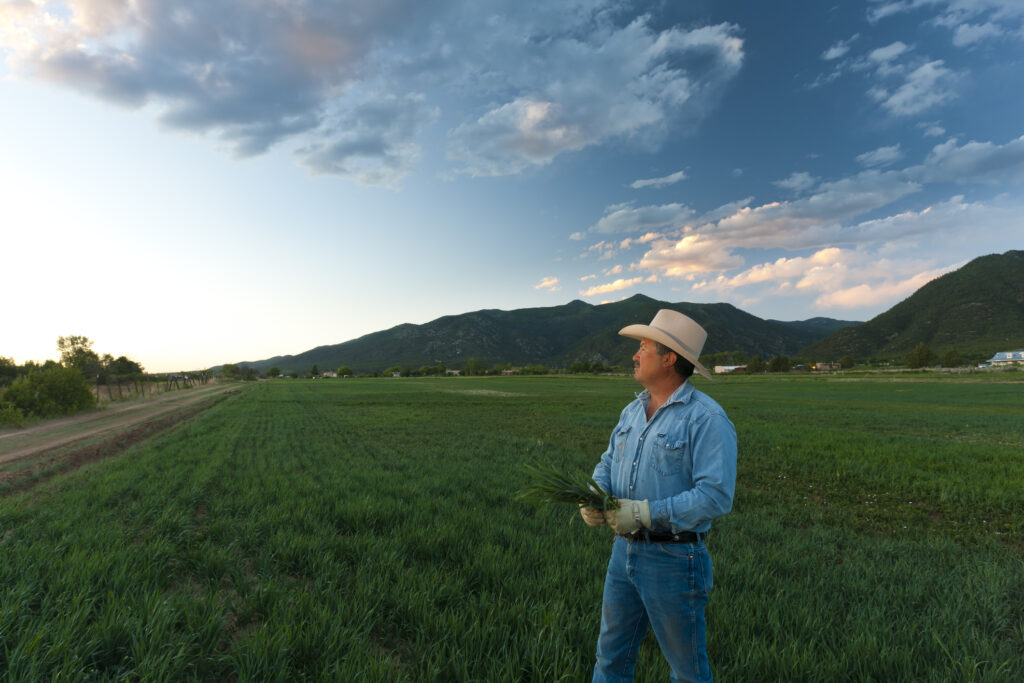
As a systems change funder, Thornburg works to empower our partners to conduct coordinated and effective advocacy for climate resilience of New Mexico’s agriculture, land, and water resources. An advocacy process starts much earlier than the legislative session, and is informed by broad, community-based work. A key moment when the community informs the legislative process is the interim legislative committee meetings.
As New Mexico’s Water & Natural Resources Committee (WNRC) met this year, the agenda reflected the realities facing farmers, ranchers, and rural communities across the state: dwindling snowpack, longer droughts, more intense wildfires, and mounting pressure on acequia infrastructure. These challenges are not abstract—they shape how food is grown, how ranching persists, and how water flows from mountain headwaters to valley fields. Thornburg Foundation grantees are not just responding to these pressures; they are helping chart a path forward, showing how healthy farms and ranches, resilient watersheds, and smart adaptation to less water are inseparable.
In northern New Mexico, Alianza Agricultura de Taos, a new Thornburg partner, is working with producers and agencies to demonstrate that regenerative grazing on public lands can heal ecosystems while sustaining rural livelihoods. Their Public Lands Grazing Innovation Initiative is building collaborative projects on federal allotments, a critical step in securing the future of ranching, where nearly 70 percent of Taos County is public land.
Meanwhile, in the Española Valley, Greenroots Institute is carrying forward acequia traditions in tandem with watershed restoration. By convening the Santa Cruz Watershed Group and mentoring young farmers through their ¡Sostenga! initiative, Greenroots is ensuring that community-led stewardship of water and land adapts to hotter, drier conditions with the next generation prepared to take on this critical work.
Upstream, the Chama Peak Land Alliance is blending culture, science, and action. Through its Thinking Like Water screenings and volunteer restoration days, it is connecting ranchers, acequia associations, and residents with low-tech erosion control and stream restoration methods—like one-rock dams and beaver analogs—that slow water, rebuild soils, and sustain irrigation flows. This work not only protects acequias but also strengthens fire and drought resilience across the Chama watershed.
At a landscape scale, the Forest Stewards Guild is advancing conservation finance strategies for the 2-3-2 Partnership, which spans 5 million acres of headwaters critical to New Mexico communities and agriculture. By quantifying the economic value of watershed restoration, the Guild is helping make the case for durable public and private investment—ensuring that the forests feeding our rivers and acequias remain resilient despite federal funding uncertainties.
Adaptation also requires strengthening local food systems, as these are the primary market for 80 percent of farmers in the state. In the frontier counties of the southwest, the Frontier Food Hub has paid out more than $3 million to local growers, built seed libraries, and is launching a regional training center to prepare the next generation of producers for regenerative agriculture and climate adaptation.
Likewise, through CODECE’s Cultivando Futuro, Indigenous and Mexicano farmers are receiving soil health tests, farm planning support, and food safety training—tools that connect cultural traditions of stewardship with market viability in a water-scarce future.
Together, these efforts form a mosaic that mirrors the priorities of the Thornburg’s Land and Agriculture program, as well as those of the WNRC: safeguarding acequias, restoring watersheds, preparing for drought, and financing resilience. The throughline is clear: adapting to less water does not mean doing less—it means doing differently, with more collaboration, better science, and deeper respect for the communities who have long stewarded New Mexico’s land and water. The story of Thornburg’s partners is ultimately one of creativity, proactivity, and hope: that by aligning state priorities with on-the-ground leadership, New Mexico can secure its water future while keeping its farms, ranches, and food systems thriving.